
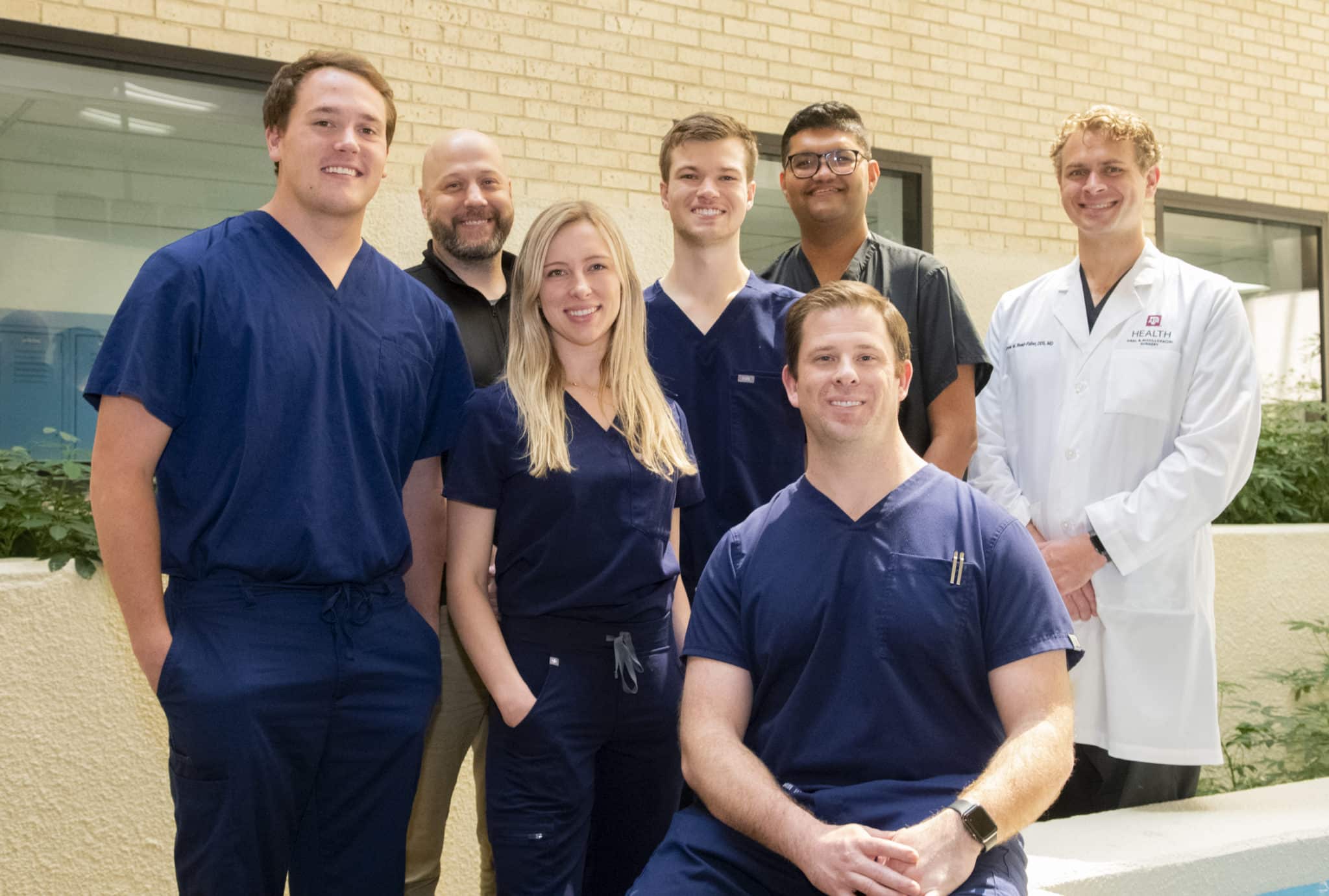
A cross-disciplinary research team at Texas A&M University, with funding from the OMS Foundation, is applying high-level technology to create a risk assessment tool for surgeons treating patients with orbital fractures. Dr. Andrew Read-Fuller, Clinical Assistant Professor and Director of Residency Training at Texas A&M’s Department of OMS, is leading a team that includes specialists in artificial intelligence (AI) and medical simulations, an anthropologist and several aspiring OMSs enrolled in the university’s dental school and residency program.
“Management of orbital fractures is challenging due to the amount of individual judgment required to evaluate the need for surgery,” Dr. Read-Fuller said. “In the absence of definitive indicators for surgery such as muscle entrapment, visible enophthalmos (sunken eye) or double vision, we’re evaluating risk based on subjective factors, which may be weighed differently by different clinicians. Our project is applying artificial intelligence (AI) to the risk-assessment process to provide surgeons with a reliable tool for determining the appropriateness of surgical intervention.”
Some 502 cases of unilateral orbital fractures were included in the dataset for the project; these were sorted by demographic, clinical, radiographic and morphometric features (38 variables in all). Analysis of fracture characteristics along with patient-specific characteristics of these cases will be incorporated into a reference tool for clinicians. With access to outcomes from comparable cases, surgeons will be better equipped to advise patients of the risks associated with untreated orbital fractures and avoid unnecessary surgery when there is a low risk of complications.
The Texas A&M team received the Foundation’s Stephen B. Milam Award for the highest-rated Research Support Grant proposal submitted in 2021; the project was funded in January 2022. By April, the team had completed the annotation of its baseline dataset using CT imaging. Design and evaluation of machine-learning models to predict outcomes of orbital fractures was the next step. A portion of the $75,000 grant was used to set up a new OMFS Imaging Research Lab at Texas A&M, a collaborative space equipped with high-performance computers to support ongoing clinical research in oral and maxillofacial surgery.
Dr. Read-Fuller also credits the Foundation grant with helping to support the development of several aspiring OMSs on the team. Dr. Ritesh Bhattacharjee completed his PhD in oral & cranial biomedical sciences in June and began clinical training in oral and maxillofacial surgery at the university’s College of Dentistry in July.
Another team member, Neil Mascarenhas – a fourth-year dental student with ambitions toward OMS residency – received training in CT imaging and 3D image rendering and processing with support from the grant. He was invited to present an abstract at the 2022 AAOMS Annual Meeting’s “Hot Off the Press” trauma section on methods for estimating fracture surface area and volume of herniated contents to help assess risk of post-traumatic complications from orbital fractures. In addition, the grant supported a summer research internship in 2022 for medical and dental students and OMS residents that focused on OMS-specific clinical research and orbital trauma.
“This grant is already helping to expand our understanding of ways to use AI in the practice of oral and maxillofacial surgery,” Dr. Read-Fuller said. “While today’s project is specific to facial trauma, we expect this sophisticated technology to have applications for every OMS in the not-too distant future. Meanwhile, by providing research training and mentorship to dental students and residents, we’re cultivating the next generation of OMS researchers who will have their own impact on the specialty.”
Your support of the Annual Fund makes projects like this one possible. If you haven’t already, please consider becoming an OMSFIRE donor today.